
1. Welcome to the Infinite Plane

Out in the far reaches of space there is an enormous Disc, about 700,000 kilometers across and 650 kilometers thick. Scattered across its surface are hundreds of Regions. Each Region is a small, self-contained flat world ringed by towering ice walls or treacherous mountains. The people of each Region live in isolation, unaware that the others exist. A sun and moon cross the sky on schedule, so most never suspect they live on anything but an ordinary world.
The Disc was built by the Necronians, an ancient civilization that conquered space and time and then grew bored with ordinary reality. Their nanotechnology, the nanytes, lets them live for hundreds of thousands of years and wield what looks like immense magick. They built the Infinite Plane to study and to entertain. A Goddess watches over each Region and chooses its era: a Western frontier, a steampunk city, a dungeon-riddled kingdom, a modern metropolis. Above them all is Adruqu, the Mother Goddess, who rules the entire Plane.
That is why one game system can run every genre. On the Infinite Plane, a knight, a gunslinger and a starship engineer can all exist, sometimes only an ice wall apart.
What is a roleplaying game?
In a roleplaying game, each player creates a character and describes what that character does. One person, the Session Master (SM), describes the world, plays everyone else the characters meet, and decides what happens. When the outcome of an action is uncertain, you roll dice to find out. Together you tell a story no one could have written alone.
A single play meeting is a session. A series of connected sessions is a campaign.
What you need
- This booklet.
- One twenty-sided die (d20) for each player. A few six-sided dice (d6) help too.
- A character sheet for each player (there is one at the back of this booklet), pencils and an eraser.
- Two to six friends and three or four hours.
Dice are written as the number of dice, the letter d, and the number of sides. 2d6+1 means roll two six-sided dice, add them, then add 1. The full rules also use d3, d4, d8, d12, d50, d100 and d1000 for special cases. IPRPS is pronounced I-PER-PASS.
What is in Lite, and what is not
IPRPS Lite gives you everything you need to build characters and play: the core roll, character creation with a starter set of advantages, disadvantages and skills, the Standard combat mode, injury and recovery, and four ready-to-play characters. The complete First Edition adds hundreds more skills and traits, full species rules, the Trinity, Dual-Die and Rock-Paper-Scissors combat systems, the size and weapon-scaling system, technology levels, and much more. A list is at the end of this booklet. Everything in Lite works the same way in the full rules, so nothing you learn here is wasted.
2. The Core Roll
Almost every roll in the Infinite Plane is a d20. There are four kinds of roll:
- Success rolls test whether an action works.
- Effectiveness rolls test how well a hit lands in combat.
- Reaction rolls tell the SM how a character the players meet feels about them.
- Damage rolls measure harm from an attack or an accident.
Success rolls
When your character tries something risky, the SM calls for a success roll using one of your skills and the attribute that skill depends on.
- Find your Skill Shift. Divide your skill level by 10 and drop any fraction. A skill of 0 to 9 gives +0; 10 to 19 gives +1; 20 to 29 gives +2; and so on, up to +10 at skill 100.
- Find your Attribute Shift from the table below.
- Roll 1d20 and add both shifts, plus any modifiers the SM applies.
- Read the total on the Base Bands.
| Total | Result | What happens |
|---|---|---|
| 1 to 6 | Fail | The action clearly fails. |
| 7 to 12 | Uncertain | The SM decides: a partial success, a success with a complication, or a near miss. |
| 13 or more | Success | The action works. |
| Attribute score | Description | Shift |
|---|---|---|
| 1 to 4 | Feeble | −3 |
| 5 to 7 | Poor | −2 |
| 8 to 9 | Below average | −1 |
| 10 | Average | 0 |
| 11 to 14 | Above average to honed | +1 |
| 15 to 19 | Exceptional | +2 |
| 20 to 49 | Heroic | +3 |
| 50 to 99 | Demigod | +4 |
| 100 | Divine | +5 |
The uncertain zone is the heart of the system. A total of 7 to 12 hands the moment to the SM, who should make it interesting: the lock opens but the pick snaps, the shot hits the shoulder instead of the heart, the guard believes you but wants a bribe.
Attribute rolls
Sometimes no skill applies, such as holding your breath, resisting poison, or staying conscious. Then the SM calls for an attribute roll: roll 1d20, add only your Attribute Shift, and read the Base Bands. "Roll Constitution" means an attribute roll on CON.
Skills with two attributes
Some skills list two attributes. If they are joined by or (Climbing uses STR or DEX), the SM picks the one that fits the moment: hauling yourself up a rope is STR, picking a path across a ledge is DEX. If they are joined by and (Ranged Weapons uses DEX and INT), use the average of the two scores, dropping fractions, to find your Attribute Shift.
Modifiers
Conditions change the odds. Darkness, distraction, poor tools, injury and haste give penalties. Good tools, preparation, time and help from friends give bonuses. Modifiers add to or subtract from your total, not the die. A stressful situation is usually worth −2 to −5. Modifiers stack unless the SM rules otherwise.
Do not roll for routine actions your character does every day, or for things that would obviously succeed. Roll when failure matters.
Critical results
Look at the die itself before adding anything. A natural 18, 19 or 20 is a critical success: something especially good happens. A natural 1, 2 or 3 is a critical failure: a tool breaks, a spell backfires, a conversation turns hostile. The SM decides the exact effect.
Untrained skills
You can attempt most skills you never learned. Your skill level is 0, so your Skill Shift is +0 and you rely on raw talent. Untrained attempts are slower and sloppier, and failure tends to create new problems: an untrained shooter may hit a friend. Some skills cannot be tried untrained at all, such as advanced magick, surgery, or high-level engineering. The SM decides.
Contests
When two characters oppose each other directly, both make success rolls.
- Quick contest (one roll each, for fast actions like grabbing for a dropped knife): a success beats a failure. If both succeed, the higher total wins. If both fail, the higher total still wins. A tie means neither gains the edge.
- Regular contest (prolonged effort like arm-wrestling or a debate): both sides roll repeatedly until one succeeds and the other fails. The SM decides how much time each roll represents.
Repeated attempts
Some actions allow only one try, such as defusing a device or giving a speech. Others can be retried, such as researching or practicing. The SM decides whether retries are allowed and what risks pile up with each failure.
Reaction rolls
When the players meet someone whose attitude is not already set, the SM rolls 1d20 in secret and adds reaction modifiers. Unlike a success roll, there is no target number: higher is simply better. Modifiers come from appearance, Charisma, conduct, reputation, cultural or species prejudice, and good roleplaying. Polite, clever dialogue earns a bonus; insults and threats earn a penalty.
| Total | Reaction | How the character behaves |
|---|---|---|
| 0 or less | Disastrous | Acts against the players in extreme ways: betrayal, violence or sabotage. |
| 1 to 4 | Very bad | Strongly dislikes them and works against them when possible. |
| 5 to 8 | Bad | Indifferent or hostile. Helps only for clear personal gain. |
| 9 to 11 | Poor | Little interest. Suspicion, delays or unreasonable demands. |
| 12 to 14 | Neutral | Detached. Business proceeds normally if customs are followed. |
| 15 to 17 | Good | Favorable. Gives reasonable help within normal limits. |
| 18 to 19 | Very good | Respectful. Generous help, fair deals, useful information. |
| 20 or more | Excellent | Admiration or loyalty. Acts in their best interest, even at personal risk. |
3. Creating a Character
Start with two questions: who is your character, and what role do they play in the story? Talk with your SM about the kind of game you are playing, then build the character in eight steps.
- Concept. Decide background, profession and personality: a wandering mercenary, an arcane scholar, a frontier lawkeeper, a streetwise investigator.
- Get your points. The SM tells you how many Development Points (DP) you have.
- Buy attributes. All start at 10 for free.
- Buy skills. All start at 0.
- Choose advantages, disadvantages and quirks.
- Record secondary characteristics: Hit Points, Basic Speed, Dodge, Basic Move and Perception.
- Choose equipment with your SM, and note your damage.
- Review with the SM, who approves the finished character.
Development Points
Development Points, also called character points, are the currency of character creation. Attributes, skills and advantages cost points. Limits and drawbacks give points back. If you start with 125 points, buy 75 points of advantages and take 15 points of disadvantages, you have 65 points left to spend.
| Points | Tier | Who fits here |
|---|---|---|
| Under 30 | Feeble | Children, helpless dependents. |
| 30 to 70 | Average | Everyday people: clerks, drivers, laborers. |
| 70 to 100 | Competent | Trained or experienced people with a clear edge. |
| 100 to 150 | Exceptional | Highly trained professionals and standout performers. |
| 150 to 250 | Heroic | The peak of realistic achievement. |
| 250 to 300 | Larger than life | Central figures of cinematic or mythic stories. |
| 300 to 500 | Legendary | Icons of epic tales and folklore. |
For a first campaign, 100 to 150 points is a good start. The full rules add the Blessed (500 to 700 points) and Divine (1,000 to 2,000 points) tiers.
Disadvantage limit. To keep characters playable, the total of all disadvantages is usually capped at half the starting points: no more than 50 points of disadvantages in a 100-point game.
Attributes
| Attribute | What it measures |
|---|---|
| Strength (STR) | Physical power and body mass: lifting, carrying, striking, grappling. Sets your hand-to-hand damage. |
| Dexterity (DEX) | Agility, balance, coordination and precision. Combat accuracy, delicate tasks and quickness. |
| Constitution (CON) | Endurance and health. Sets your Hit Points and resists poison, disease, fatigue and collapse. |
| Intelligence (INT) | Reasoning, memory and creativity. Scientific, technical and magickal skills. Sets Perception. |
| Wisdom (WIS) | Perception and judgment: noticing, reading people, surviving outdoors. |
| Charisma (CHA) | Presence and influence: persuading, leading, performing. |
| Will Power (WIL) | Mental resilience against fear, coercion, interrogation, torture and supernatural influence. Also used to cling to life. |
| Mana Pool (MP) | Magickal energy and control. Only magick users need to raise it. |
Every attribute starts at 10, average for a human, at no cost. Most people fall between 8 and 12. A score of 15 is exceptional; 20 is heroic and beyond normal human limits. Check with the SM before going above 20.
| Score | Description | INT or DEX | All other attributes |
|---|---|---|---|
| 1 | Feeble | gain 18 DP | gain 18 DP |
| 5 | Poor | gain 10 DP | gain 10 DP |
| 8 | Below average | gain 4 DP | gain 4 DP |
| 9 | Weak | gain 2 DP | gain 2 DP |
| 10 | Average | 0 DP | 0 DP |
| 11 | Above average | cost 10 DP | cost 5 DP |
| 12 | Honed | cost 20 DP | cost 10 DP |
| 15 | Exceptional | cost 50 DP | cost 25 DP |
| 20 | Heroic | cost 100 DP | cost 50 DP |
In short: raising INT or DEX costs 10 DP per level above 10. Raising any other attribute costs 5 DP per level. Lowering any attribute below 10 gives back 2 DP per level. The lowest score for a working character is 1.
Secondary characteristics
These come straight from your attributes. Work them out after buying attributes, and again whenever an attribute changes.
| Value | How to work it out |
|---|---|
| Hit Points (HP) | 50 + (CON × 10) + (Level × 5). New characters are Level 1 unless the SM says otherwise. Adjust for Size (see Species), dropping fractions. |
| Basic Speed | (DEX + CON) ÷ 4. Keep the decimals for working out Dodge. When writing Basic Speed on the sheet, drop the decimals, but round up if the decimal part is .85 or more. |
| Dodge | Basic Speed (with decimals) + ((DEX − 10) ÷ 2). Drop fractions from the final number. |
| Basic Move | Basic Speed with fractions dropped, in yards per second. Multiply by 0.9 for meters. |
| Perception (Per) | Equal to INT. The SM rolls against it to see whether you notice hidden things and danger. |
Hit Points measure both injury and stamina. Wounds, exhaustion, hunger and hazards all come off the same pool.
Appearance, Charisma and wealth
| Appearance | Points | Reaction modifier |
|---|---|---|
| Hideous | −10 | −5 |
| Ugly | −6 | −3 |
| Unattractive | −4 | −1 |
| Average | 0 | 0 |
| Attractive | +5 | +2 |
| Handsome or Beautiful | +10 | +5 from those attracted to your type, +3 from others |
| Very Handsome or Very Beautiful | +15 | +8 from those attracted to your type, +5 from others |
Charisma (the advantage) costs 5 points per level. Each level gives +1 on reaction rolls in direct conversation and +1 to Leadership and public speaking. This is separate from your CHA attribute.
| Wealth | Points | Meaning |
|---|---|---|
| Dead broke | −20 | Owns nothing beyond what is carried. |
| Poor | −15 | One fifth of average starting wealth. Limited jobs. |
| Struggling | −10 | Half of average wealth. Income barely covers needs. |
| Average | 0 | The norm for the setting. |
| Comfortable | +15 | Twice average starting wealth. |
| Wealthy | +40 | Five times average starting wealth. |
| Very wealthy | +50 | Twenty times average starting wealth. |
The SM sets what average starting wealth means in the Region where you play. The full rules add higher wealth levels, technology level, languages, reputation and status.
Advantages
Advantages are special abilities that make your character stand out. Choose ones that support your concept and create good scenes, not just bigger numbers. Costs are guides; the SM may adjust them.
| Advantage | Cost | Effect |
|---|---|---|
| Acute Senses | 5 per level per sense | +1 per level to Perception rolls with one sense: hearing, sight, smell, touch or taste. |
| Ambidexterity | 10 | No penalty for using either hand. |
| Animal Empathy | 5 | You understand the moods and motives of animals. |
| Catfall | 10 | You reduce falling damage and control your body as you fall. |
| Combat Reflexes | 15 | +2 to defense, resist surprise, and shake off mental stun twice as fast. |
| Common Sense | 10 | The SM warns you before you do something obviously foolish. |
| Contacts | 10 | People who give you information or small favors. |
| Darkvision | 10 | You see clearly in darkness out to a set range. |
| Fearlessness | 2 per level | +1 per level to resist fear. |
| High Pain Threshold | 20 | You ignore shock penalties and resist being stunned by injury. |
| Iron Will | 10 per level | +1 per level to resist coercion and mental influence. |
| Luck | 5 to 30 | A few times per session, reroll a bad result. The SM sets how often. |
| Magick Affinity | 10 | You have a natural gift for magick. |
| Natural Armor | 5 per level | Skin, hide or scales: +1 protection per level against every hit. |
| Resistant | 10 | Better resistance to one hazard, such as poison or disease. |
| Voice | 10 | +3 to skills involving speech or singing, and +1 reaction from anyone who hears you. |
Disadvantages
Disadvantages are flaws that give back points and create roleplaying. They only work if you play them. Some need a self-control roll: when the flaw is triggered, make a Will Power roll. On a failure, the flaw takes over.
| Disadvantage | Points | Effect |
|---|---|---|
| Bad Sight | −10 or −25 | −6 on sight-based Perception and −2 on attacks where sight matters. −10 where glasses exist, −25 where they do not. |
| Bad Temper | −10 | Under stress, a self-control roll. Failure means lashing out at the source. |
| Code of Honor | −5 to −15 | You live by a strict code even when it costs you. |
| Curious | −5 | You must investigate strange things, even dangerous ones. |
| Greed | −15 | Money tempts you past good sense. |
| Hard of Hearing | −10 | −4 on hearing-based Perception and on understanding speech. |
| Honesty | −10 | You obey laws and rules, and hate breaking them. |
| Impulsiveness | −10 | You act first and think later. |
| Nightmares | −5 | Bad dreams disturb your rest. |
| One Eye | −15 | No depth perception; penalties to ranged attacks and Perception. |
| Overconfidence | −5 | You believe you can handle anything. |
| Pacifism | −5 or −10 | You refuse to kill, or to fight at all. |
| Phobia | −5 to −15 | An irrational fear. Facing it calls for a self-control roll. |
| Sense of Duty | −2 to −20 | You will not abandon a group, cause or person. |
| Truthfulness | −5 | You find it very hard to lie. |
| Unluckiness | −10 | When things can go wrong for you, they do. |
| Vow | −5 to −15 | A solemn promise that limits what you do. |
Quirks
A quirk is a small, persistent trait: tapping your fingers when nervous, speaking too formally, refusing to lie for personal gain, collecting buttons. Quirks add personality without crippling you. Each is usually worth −1 point, and the SM approves them. Quirks also include unusual habits, prejudices and preferences; agree on these with your SM and your group before play.
Skills
A skill is training and practice. Your attribute shows potential; your skill shows what you do with it. Skills start at level 0 and are bought on the Ascendant Scale. You pay the cumulative cost of the level you want.
| Level | Rank | Cost per level | Total cost to reach the top of the range |
|---|---|---|---|
| 0 | Instinctual (untrained) | 0 | 0 |
| 1 to 3 | Natural | 1 DP | 3 DP at level 3 |
| 4 to 9 | Competent | 2 DP | 15 DP at level 9 |
| 10 | Average professional | 5 DP | 20 DP |
| 11 to 14 | Honed | 3 DP | 32 DP at level 14 |
| 15 | Exceptional | 10 DP | 42 DP |
| 16 to 19 | Elite | 5 DP | 62 DP at level 19 |
| 20 | Heroic | 15 DP | 77 DP |
Level 10 is a working professional. Level 15 is an Olympian or grandmaster. Level 20 is an action hero. The full rules continue the scale to Master (21 to 49), Demigod (50), Mythic (51 to 99) and Divine (100).
A weapon specialty such as Shortsword, Dagger or Spear is a narrower form of Melee Weapons and costs the same. Use the specialty for that weapon only.
| Skill | Attribute | Covers |
|---|---|---|
| Acrobatics | DEX | Tumbling, flips, rolling with falls. |
| Animal Handling | WIS | Calming, training and riding animals. |
| Athletics | STR | Running, jumping, lifting, throwing, forcing doors. |
| Balance | DEX | Keeping your footing on unstable ground. |
| Brawling | STR | Unarmed strikes, clinches, headbutts and dirty fighting. |
| Channeling | INT and MP | Pulling raw magick through the body for fast effects. |
| Climbing | STR or DEX | Scaling walls, cliffs, ropes and trees. |
| Computing | INT | Using and programming computers, where they exist. |
| Concentration | WIL | Keeping focus despite pain and distraction. |
| Cooking | WIS or DEX | Preparing good, safe food. |
| Deception | CHA | Lying, bluffing and disguising intent. |
| Diplomacy | CHA or WIS | Negotiating between parties and calming conflict. |
| Endurance | CON | Resisting fatigue, pain, heat, cold and hunger. |
| Engineering | INT | Designing, building and repairing structures and machines. |
| First Aid | INT | Stopping bleeding and stabilizing the wounded. |
| Grappling | STR or DEX | Holds, throws, pins and escapes. |
| Heavy Weapons | STR | Greatswords, warhammers, halberds. |
| Insight | WIS | Reading motives and spotting lies. |
| Intimidation | CHA or STR | Frightening others into cooperating. |
| Leadership | CHA | Directing and inspiring a group. |
| Lore | INT | Knowledge of history, legends and a chosen subject. |
| Martial Arts | DEX and STR | Trained unarmed fighting: precision and leverage. |
| Mechanic | INT or DEX | Repairing engines and mechanisms. |
| Melee Weapons | STR or DEX | Swords, axes, clubs, spears and knives. |
| Mental Resistance | WIL | Resisting mind control and psychic attack. |
| Navigation | INT or WIS | Finding your way by map, stars or landmarks. |
| Parry | DEX | Deflecting attacks with a weapon or limb. |
| Perception | WIS | Actively searching and noticing details. |
| Performance | CHA | Acting, singing, music and storytelling. |
| Persuasion | CHA or INT | Convincing with argument and charm. |
| Ranged Weapons | DEX and INT | Bows, crossbows and firearms. |
| Restoration | WIS and MP | Healing magick. |
| Scavenging | WIS | Finding useful materials in ruins and waste. |
| Shield Use | DEX | Blocking with a shield. |
| Spellcasting | INT and MP | Casting learned spells by formula, sigil and word. |
| Stealth | DEX | Moving silently and staying hidden. |
| Streetwise | WIS or CHA | Finding contacts, rumors and black markets. |
| Survival | WIS | Finding food, water and shelter in the wild. |
| Swimming | STR or CON | Swimming and staying afloat. |
| Tactics | INT | Planning fights, flanking and initiative advantage. |
| Thrown Weapons | DEX | Knives, axes, spears and stones thrown by hand. |
| Tracking | WIS | Following trails and signs. |
The full rules contain more than 450 skills, including crafts, medicine by technology level, schools of magick, and specialist skills for running guilds, academies, taverns, towns and temples.
Species
The Infinite Plane is home to many peoples. In Lite, a species sets your Size and gives you a guide for attributes. Size changes the damage you deal, how easy you are to hit, and your Hit Points.
| Species | Size | Typical traits |
|---|---|---|
| Human | 0 | Balanced and adaptable. No strong biases. |
| Elf | 0 | High DEX and perception; lower STR and CON. Resist charm and fear. |
| Dwarf | 0 | High STR and CON; lower DEX. Resist poison and disease. |
| Orc | +1 | High STR and CON; lower INT. Push through pain. |
| Goblin | −2 | High DEX and perception; lower STR. Sneaky and cautious. |
| Cat Beastfolk | −1 | High DEX and perception. Night vision; agile climbers. |
| Dog Beastfolk | 0 | Keen smell, loyal and social, good endurance. |
| Bear Beastfolk | +1 | Very high STR and CON; lower DEX. |
| Insectoid worker | −2 | Hardy hive laborers; warriors are Size 0. |
| Size | Height | To hit this creature | Damage it deals | Hit Points |
|---|---|---|---|---|
| −2 | 2 to 4 ft | −2 | −4 | −30% |
| −1 | 4 to 5 ft | −1 | −2 | −15% |
| 0 | 5 to 7 ft | 0 | 0 | no change |
| +1 | 7 to 9 ft | +1 | +2 | +25% |
| +2 | 9 to 14 ft | +2 | +4 | +50% |
The full rules include species advantages and disadvantages for twelve species, sizes from −3 to +6 (pixies to ancient dragons), and Size effects on reach, grappling, knockback, movement and stealth.
4. Combat
Combat is fast and dangerous. Position, timing and morale matter as much as damage, and surrender, retreat and negotiation are always worth considering. Lite uses the Standard combat mode: roll initiative order, roll to hit, then roll damage.
Turns and initiative
Combat runs in turns of about one second. Characters act in order of Basic Speed, highest first. If two are tied, the higher DEX goes first; if still tied, the SM decides. When everyone has acted, a new turn begins.
On your turn, choose one action and you may also move a short distance, up to your Basic Move. Actions include attacking, aiming, casting a spell, using an item, diving for cover, or one of the maneuvers below.
| Maneuver | Effect |
|---|---|
| Attack | Make one attack. |
| All-Out Attack | A bonus to your attack, but you cannot defend this turn. High risk, high reward. |
| All-Out Defense | A bonus to your defense, but no attack this turn. Useful when outnumbered. |
| Aim | Spend the turn aiming for a bonus on your next ranged attack. |
| Feint | A quick contest of skills. If you win, your opponent defends worse against your next attack. |
| Grapple | A quick contest of STR or Grappling. The winner controls the opponent. |
| Move and Attack | Move your full Basic Move and make one attack at a penalty. |
| Wait | Hold your action, then interrupt someone else's turn. |
The SM sets the size of maneuver bonuses and penalties to fit the fight; +2 or −2 is a good start.
Making an attack
- Roll to hit. Make a success roll with your combat skill (Brawling, Melee Weapons, Ranged Weapons and so on). Add the target's Size modifier: big creatures are easier to hit. On a success, you hit. On a 7 to 12, the SM decides whether you graze, are deflected, or miss. On a failure, you miss.
- The target defends. If the target knows the attack is coming, it may try one defense (see below). A successful defense stops the attack.
- Roll effectiveness. Roll 1d20 to see how cleanly the hit landed (see the table below).
- Roll damage. Roll the attack's damage, multiply by the effectiveness result, drop fractions (minimum 1), and subtract the target's armor. The rest comes off the target's Hit Points.
| Roll (1d20) | Result | Damage |
|---|---|---|
| 13 to 20 | Clean hit: full force, the target fails to slip or turn. | Full |
| 7 to 12 | Solid hit, partly guarded or off-angle. | Half |
| 1 to 6 | Glancing blow: it barely connects. | Quarter |
Defending
A character who sees an attack coming may try one defense against it:
- Dodge. Roll 1d20. If the roll is equal to or less than your Dodge, you avoid the attack.
- Parry. Make a success roll with Parry, or with the weapon you are holding, to deflect the blow. You cannot parry bullets or large creatures without special gear.
- Block. Make a success roll with Shield Use. A defensive magick barrier counts as a Block.
Each extra defense you attempt in the same turn is harder; the SM applies a growing penalty. Poor footing, surprise and exhaustion also reduce defenses. A surprised character cannot defend at all.
Damage
Your Strength sets the damage of punches, kicks and muscle-powered weapons. Thrust is for straight-line attacks: punches, bites, spears, rapiers, daggers. Swing is for weapons swung in an arc: axes, clubs, maces and most swords. Write thrust and swing on your sheet separated by a slash, for example 1d20−1/2d20−1.
| STR | Punch | Kick | Thrust | Swing |
|---|---|---|---|---|
| 1 to 2 | 1d20−8 | 1d20−7 | 1d20−6 | 1d20−5 |
| 3 to 4 | 1d20−7 | 1d20−6 | 1d20−5 | 1d20−4 |
| 5 to 6 | 1d20−6 | 1d20−5 | 1d20−4 | 1d20−3 |
| 7 to 8 | 1d20−5 | 1d20−4 | 1d20−3 | 1d20−2 |
| 9 | 1d20−4 | 1d20−3 | 1d20−2 | 1d20−1 |
| 10 | 1d20−4 | 1d20−3 | 1d20−2 | 1d20 |
| 11 | 1d20−3 | 1d20−2 | 1d20−1 | 1d20+1 |
| 12 | 1d20−3 | 1d20−2 | 1d20−1 | 1d20+2 |
| 13 | 1d20−2 | 1d20−1 | 1d20 | 2d20−1 |
| 14 | 1d20−2 | 1d20−1 | 1d20 | 2d20 |
| 15 | 1d20−1 | 1d20 | 1d20+1 | 2d20+1 |
| 16 | 1d20−1 | 1d20 | 1d20+1 | 2d20+2 |
| 17 | 1d20 | 1d20+1 | 1d20+2 | 3d20−1 |
| 18 | 1d20 | 1d20+1 | 1d20+2 | 3d20 |
| 19 | 2d20−3 | 2d20−2 | 2d20−1 | 3d20+1 |
| 20 | 2d20−3 | 2d20−2 | 2d20−1 | 3d20+2 |
Add the attacker's Size damage modifier (see Species). If damage drops below 1 on a hit, it still does 1. For bows, crossbows, firearms and quick play, the SM may use the typical weapon damage below instead.
| Weapon | Damage | Notes |
|---|---|---|
| Knife or dagger | 1d6 | Concealable, quick. |
| Shortsword | 1d6+1 | Balanced, versatile. |
| Spear | 1d6+2 | Reach; can be thrown. |
| Longsword | 2d6 | The standard melee weapon. |
| Warhammer | 2d6+1 | Crushing. |
| Greatsword | 3d6 | Two-handed, slow. |
| Bow | 1d6+1 | Needs arrows. |
| Crossbow | 2d6 | Pierces armor; slow to reload. |
| Pistol | 2d6 | Limited ammunition. |
| Rifle | 3d6+2 | Long range, accurate. |
Armor has a protection value set by the SM for the setting. Subtract it from the damage of every hit it covers. Natural Armor adds +1 protection per level.
Quick skirmishes: Rock, Paper, Scissors
For bar brawls, minor minions and ambushes where detail would slow the story, the SM may resolve a whole exchange in one beat. Each side secretly picks a stance and reveals it at once:
- Rock: a heavy attack, stomp or magick blast. Beats Scissors.
- Paper: block, counter or ward. Beats Rock.
- Scissors: a fast strike, feint or precise spell. Beats Paper.
The winner deals full damage and the loser deals only quarter damage. A tie deals half damage to both sides. Describe the result in a sentence and move on. The full rules expand this into a complete combat system, alongside the Trinity and Dual-Die systems.
5. Injury, Fatigue and Recovery
Hit Points (HP) track both injury and exhaustion. Cuts, bullets, burns, poison, sprinting and hunger all drain the same pool. Track your current HP all the time.
| Current HP | Effect |
|---|---|
| Below one third of maximum | You stagger. Halve your Basic Move and Dodge, rounding up. |
| 0 or less | At the start of each of your turns, roll Constitution to stay conscious, if you plan to act, defend or move hard. If you do nothing at all, no roll is needed. |
| −1 × maximum HP | Roll Constitution at once to avoid death. Roll again at −2×, −3× and −4×. |
| −5 × maximum HP | Death, for most living beings. |
Shock
When you take damage, you flinch. Until the start of your next turn, take a penalty equal to the HP you lost, up to −4, on DEX-based and INT-based skills. Shock does not reduce Dodge, Parry or Block.
Major wounds
A single hit that takes more than half your maximum HP is a major wound. Roll Constitution. On a success, you suffer only shock. On a failure, you are stunned and knocked down, dropping what you hold. While stunned you do nothing on your turn and defend at −4; roll Constitution at the end of each turn to shake it off. If you fail the first roll by 5 or more, you fall unconscious.
Waking up
- With 1 HP or more: you wake within fifteen minutes.
- At 0 HP or below, but above −1 × maximum HP: roll Constitution every hour to wake. You still suffer the below-one-third penalties.
- At −1 × maximum HP or worse: you need medical help or magick to wake.
Recovery
| Method | HP restored |
|---|---|
| Natural rest | Roll Constitution at the end of each full day of rest with shelter and food. Success restores 10 HP. |
| First aid | About one minute of binding and pressure stops bleeding and restores 10 HP. |
| Medical treatment | A Medicine or First Aid roll restores more, depending on tools, time and technology level. |
| Magickal healing | Depends on the spell. Can be instant and large. |
| Quiet rest after exertion | 1 HP per 10 minutes, if the loss came from exertion rather than wounds. |
Fatigue and hazards
| Activity | HP cost |
|---|---|
| A fight longer than 10 turns | 20 HP afterward for everyone who fought, defended, sprinted or cast spells. |
| Forced march | Roll Constitution each hour of hard travel. Failure costs 10 HP. |
| Sprinting | Roll Constitution after every 15 seconds. Failure costs 10 HP. |
| Hard swimming | Roll Constitution after every minute. Failure costs 10 HP. |
| No food or water | 50 HP per day; only 5 HP per day if you have water. |
| No sleep | After 16 hours awake, roll Constitution every 4 hours. Failure costs 10 HP. |
| Extreme heat or cold | Roll Constitution on a schedule the SM sets. Failure costs 10 HP. |
Fire, poison and disease cost HP as the SM rules for the source; resist poison and disease with Constitution. Without air, you lose HP fast; at 0 HP, roll Will Power each turn to keep acting, and unconsciousness follows soon after.
Death carries weight. In some Regions it is final. In others, advanced technology, divine bargains or rare magick can bring characters back, always at a cost. The first people brought to the Plane were clones, and some Goddesses can move a consciousness into a new body.
6. Magick in Brief

Magick on the Infinite Plane is nanyte technology so advanced it seems supernatural. If your SM allows magick, raise your Mana Pool (MP) attribute and buy a magick skill such as Spellcasting, Channeling or Restoration. Cast a spell with a success roll on that skill.
Your mana pool, the points you spend to cast, is rolled once when you create the character:
In Lite, the SM sets each spell's mana cost and effect. Treat attack spells like projectiles or blows: roll to hit, roll effectiveness and roll damage. The full rules add more than thirty schools of magick, from Elemental Manipulation and Necromancy to Chronomancy, with costs and casting rules.
7. Running the Game
The Session Master creates the world: its era, laws, languages, technology and economy. A few tips:
- Say yes, then roll. Let players try clever things. Use the uncertain zone (7 to 12) to add twists instead of flat failures.
- Combat is deadly. Even weak opponents threaten injured characters. Give enemies goals besides killing: they flee, surrender or bargain.
- Raise the stakes with modifiers. Stress, darkness and haste are usually worth −2 to −5.
- Use reaction rolls when you do not already know how someone feels about the players. Then play the result.
- Award points. After each session, give each player 1 to 5 points for playing well, taking part and moving the story. Major milestones can earn more. Encourage players to improve skills they actually used.
- Mix technology. A medieval kingdom can hold a few steam-age devices found in ancient ruins. You control what exists.
8. Sample Characters
These four characters are ready to play. Each skill line shows the bonus to add to your d20 for a success roll (Skill Shift plus Attribute Shift). All are Level 1.
Barnaby, Bear Beastfolk brawler (100 points)
A massive, simple-living dock worker who solves problems with strength rather than technique. Size +1.
| Item | Value |
|---|---|
| Attributes (39 DP) | STR 15 (25 DP), CON 14 (20 DP), DEX 9 (gain 2 DP), INT 8 (gain 4 DP). All others 10. |
| Skills (59 DP) | Brawling 12, roll +3 (26 DP). Athletics 12, roll +3 (26 DP). Carpentry 5, roll +2 with STR (7 DP). |
| Secondary | HP 243 (195 for Level 1, +25% for Size +1). Basic Speed 5. Dodge 5. Basic Move 5. Perception 8. |
| Damage | Punch 1d20+1, kick 1d20+2 (includes +2 for Size). |
| Points | 98 spent, 2 unspent. |
Klick, Insectoid worker and tunnel fighter (120 points)
A multi-limbed hive drone who digs, shores up tunnels and holds the line. Size −2.
| Item | Value |
|---|---|
| Attributes (35 DP) | CON 13 (15 DP), STR 12 (10 DP), DEX 11 (10 DP). All others 10. |
| Skills (85 DP) | Engineering (Tunneling) 15, roll +1 (42 DP). Spear 10, roll +2 (20 DP). Survival (Underground) 10, roll +1 (20 DP). Climbing 3, roll +1 (3 DP). |
| Secondary | HP 129 (185, −30% for Size −2). Basic Speed 6. Dodge 6. Basic Move 6. Perception 10. |
| Damage | Spear (thrust) 1d20−5 (includes −4 for Size). |
| Points | 120 spent. |
"Subject 12", Gemp tech scavenger (150 points)
A Gemp (human and chimpanzee hybrid) mechanic who uses agility and intellect to strip ancient technology and slip past security. Size 0.
| Item | Value |
|---|---|
| Attributes (64 DP) | DEX 13 (30 DP), INT 13 (30 DP), CON 12 (10 DP), STR 7 (gain 6 DP). All others 10. |
| Skills (86 DP) | Engineering 12, roll +2 (26 DP). Scavenging 12, roll +1 (26 DP). Stealth 10, roll +2 (20 DP). Dagger 6, roll +1 (9 DP). Climbing 4, roll +1 with DEX (5 DP). |
| Secondary | HP 175. Basic Speed 6. Dodge 7. Basic Move 6. Perception 13. |
| Damage | Dagger (thrust) 1d20−3. |
| Points | 150 spent. |
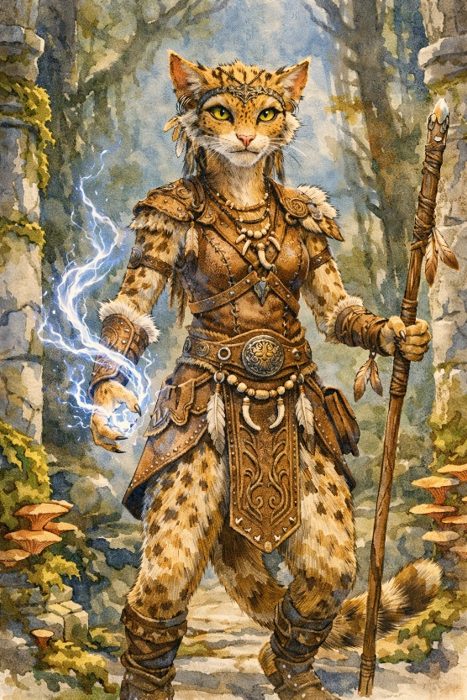
Yara, Cat Beastfolk nightblade (200 points)
A silent hunter who blends shadow magick with swift blade work. Size −1.
| Item | Value |
|---|---|
| Attributes (78 DP) | DEX 14 (40 DP), INT 12 (20 DP), MP 12 (10 DP), WIS 12 (10 DP), STR 9 (gain 2 DP). All others 10. |
| Skills (122 DP) | Stealth 16, roll +2 (47 DP). Shortsword 14, roll +2 (32 DP). Shadow Magick 10, roll +2 (20 DP). Acrobatics 10, roll +2 (20 DP). Perception 3, roll +1 (3 DP). |
| Secondary | HP 131 (155, −15% for Size −1). Basic Speed 6. Dodge 8. Basic Move 6. Perception 12. |
| Mana pool | Roll at the table: ((d1000 × 131 + 4) + 100) × 3. |
| Damage | Shortsword (swing) 1d20−3 (includes −2 for Size). |
| Points | 200 spent. |
Example of play
Yara and Barnaby are slipping onto a guarded dock at night. The SM has a dock guard ready: STR 11, DEX 10, CON 11, Melee Weapons (club) 10, HP 165, Basic Speed 5.25, Dodge 5. His club swings for 1d20+1.
- Stealth. Yara goes first. She rolls 12 and adds +2: 14. Success. She reaches the stacked crates unseen.
- Reaction. Barnaby is too big to hide, so he walks up with a coin. The SM rolls a secret reaction: 9, +2 for the offered coin, makes 11. Poor. The guard is suspicious and demands more. Barnaby swings instead.
- Initiative. Basic Speeds: Yara 6, Barnaby 5.75, the guard 5.25. Yara acts first, then Barnaby, then the guard.
- Yara attacks. She rolls 14 + 2 = 16: a hit. The guard tries to Dodge and must roll 5 or less; he rolls 9 and fails. Yara's effectiveness roll is 15: full damage. She rolls 1d20−3 and gets 13 − 3 = 10. The guard drops to 155 HP and suffers −4 shock on DEX- and INT-based skills until his next turn.
- Barnaby attacks. He rolls 6 + 3 = 9: uncertain. The SM rules his fist clips the guard. Effectiveness roll 4: quarter damage. He rolls 1d20+1 for 12 and quarters it to 3. The guard is at 152 HP.
- The guard strikes back at Yara with his club. The SM decides this swing is STR-based, so shock does not apply. He rolls 13 + 2 = 15: a hit. Yara Dodges and must roll 8 or less. She rolls 6 and twists away.
Next turn, the guard is outnumbered and bleeding. The SM decides he will shout for help unless someone stops him. What do you do?
9. Beyond Lite: the First Edition
IPRPS Lite covers the core. The Infinite Plane Role Playing System, First Edition is the complete game, sold separately. It adds:
- More than 450 skills, including crafts, medicine for every technology level, and specialist skills for guilds, academies, taverns, town governments and religious orders.
- The complete advantage, disadvantage and quirk lists, with species traits for Humans, five Beastfolk, Elves, Dwarves, Orcs, Goblins, Demons, Spirits, Reptilians and Dragonoids, Insectoids and Constructs.
- The full Ascendant Scale to level 100, from Master to Divine, and the Blessed and Divine power tiers.
- Four combat systems: Standard, Rock-Paper-Scissors, Trinity and Dual-Die, with full maneuvers and weapon scaling.
- The complete Size system for reach, grappling, knockback, movement, swimming and stealth, from pixies to ancient dragons.
- Technology levels from the Stone Age to the far future, languages, literacy, wealth to Royalty, reputation and status.
- Rules for climbing, jumping, running, flying, throwing, lifting, perception, knowledge and social influence.
- Full injury, hazard and species-difference rules, mortal wounds and resurrection.
- Thirty-plus schools of magick and the Mana Pool system in depth.
- Party building and play advice, more than a dozen sample characters from 100 to 500 points, a glossary and complete tables.
Get news about the First Edition, IPRPS OS and more free material at infiniteplane.space. Download the latest IPRPS Lite at infiniteplane.space/LITE.
10. Quick Reference
| Roll | How |
|---|---|
| Success roll | 1d20 + Skill Shift (skill ÷ 10) + Attribute Shift + modifiers. 1–6 fail, 7–12 SM decides, 13+ success. |
| Attribute roll | 1d20 + Attribute Shift + modifiers. Same bands. |
| Critical | Natural 18–20 is a critical success. Natural 1–3 is a critical failure. |
| Effectiveness | 1d20 after a hit. 13–20 full damage, 7–12 half, 1–6 quarter. |
| Dodge | 1d20, equal to or under your Dodge. |
| Damage | Dice + adds, × effectiveness, drop fractions (minimum 1), − armor. |
| Reaction | 1d20 + modifiers, read on the Reaction Table. Higher is better. |
| Value | Formula |
|---|---|
| Hit Points | 50 + (CON × 10) + (Level × 5), then Size |
| Basic Speed | (DEX + CON) ÷ 4 |
| Dodge | Basic Speed + ((DEX − 10) ÷ 2), drop fractions |
| Basic Move | Basic Speed, fractions dropped (yards per second) |
| Perception | INT |
| Mana pool | ((d1000 × HP + INT ÷ 3) + race modifier × 100) × 3 |
| Buying | Cost |
|---|---|
| INT or DEX | 10 DP per level above 10 |
| Other attributes | 5 DP per level above 10 |
| Lowering any attribute | Gain 2 DP per level below 10 |
| Skills | Level 3: 3 DP. Level 10: 20 DP. Level 12: 26 DP. Level 15: 42 DP. Level 20: 77 DP. |
| Disadvantages | No more than half your starting points |
| Quirks | Usually −1 each |
11. Character Sheet
Copy this page, or fill it in on screen. Write in pencil: numbers change in play. Use your browser's Print command to print it, or download the Word file to type into it.
| Field | Entry |
|---|---|
| Character name | blank |
| Player | blank |
| Species and Size | blank |
| Concept | blank |
| Starting points | blank |
| Points unspent | blank |
| Level | blank |
| Attribute | Score | Shift | DP spent |
|---|---|---|---|
| Strength (STR) | blank | blank | blank |
| Dexterity (DEX) | blank | blank | blank |
| Constitution (CON) | blank | blank | blank |
| Intelligence (INT) | blank | blank | blank |
| Wisdom (WIS) | blank | blank | blank |
| Charisma (CHA) | blank | blank | blank |
| Will Power (WIL) | blank | blank | blank |
| Mana Pool (MP) | blank | blank | blank |
| Value | Entry |
|---|---|
| Maximum HP | blank |
| Current HP | blank |
| One third of maximum HP | blank |
| Basic Speed | blank |
| Dodge | blank |
| Basic Move | blank |
| Perception | blank |
| Damage (thrust / swing) | blank |
| Armor protection | blank |
| Mana pool | blank |
| Skill | Attribute | Level | Roll bonus | DP spent |
|---|---|---|---|---|
| blank | blank | blank | blank | blank |
| blank | blank | blank | blank | blank |
| blank | blank | blank | blank | blank |
| blank | blank | blank | blank | blank |
| blank | blank | blank | blank | blank |
| blank | blank | blank | blank | blank |
| blank | blank | blank | blank | blank |
| blank | blank | blank | blank | blank |
| blank | blank | blank | blank | blank |
| blank | blank | blank | blank | blank |
| blank | blank | blank | blank | blank |
| blank | blank | blank | blank | blank |
| Trait | Points | Notes |
|---|---|---|
| blank | blank | blank |
| blank | blank | blank |
| blank | blank | blank |
| blank | blank | blank |
| blank | blank | blank |
| blank | blank | blank |
| blank | blank | blank |
| blank | blank | blank |
| Item | Skill | Damage | Notes |
|---|---|---|---|
| blank | blank | blank | blank |
| blank | blank | blank | blank |
| blank | blank | blank | blank |
| blank | blank | blank | blank |
| blank | blank | blank | blank |
| blank | blank | blank | blank |